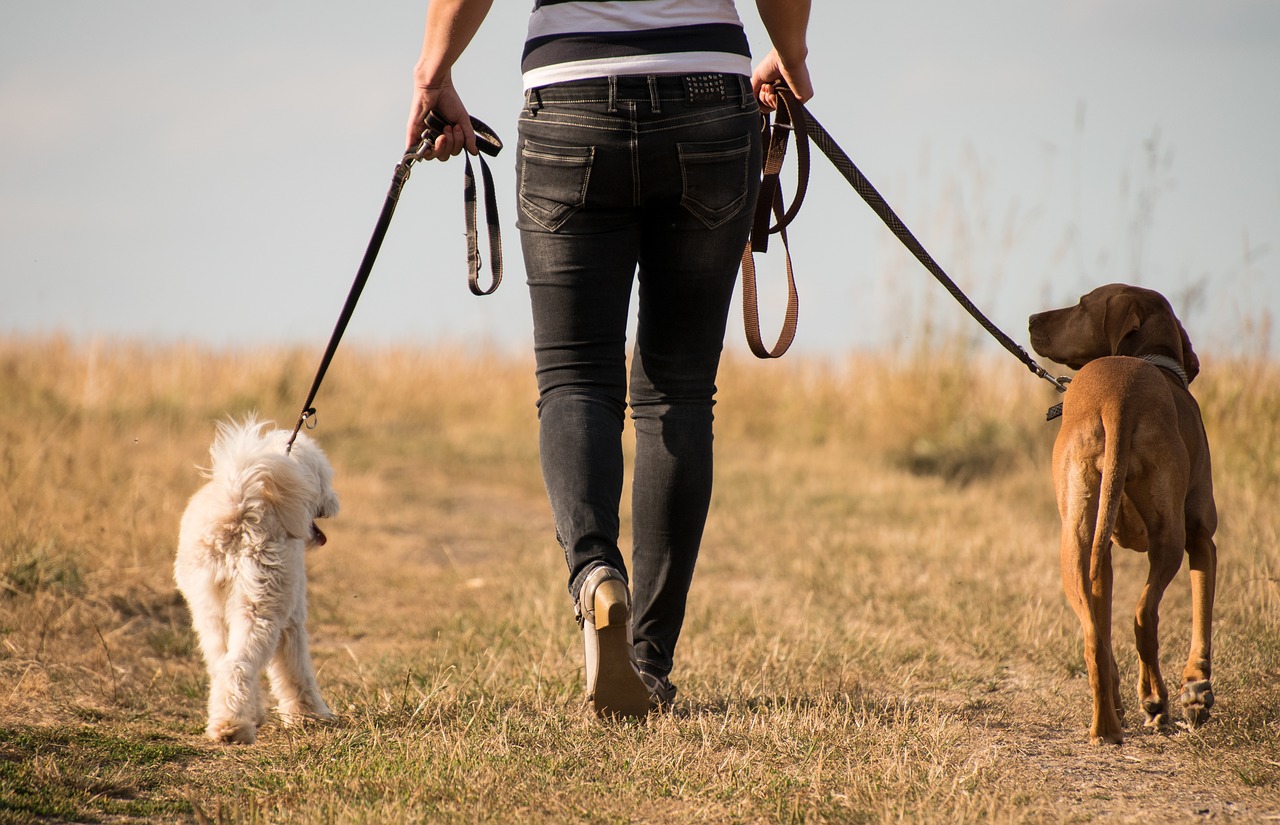
To get started, you will need:
- If you need a collar or harness, consider a buckle collar, Martingale, a head halter (such as the Gentle Leader or Halti), or a front-clip harness (such as Easy-Walk or Freedom No-pull).
- You’ll need a leash of four to six feet long (not retractable).
- Treats
You start with:
- Make sure you have treats in your pocket or treat pouch.
- Place a few treats on the side of your body that the dog should walk on. Hold treats in your left hand if you’d like your dog to walk on the left.
- Use the hand opposite the dog to hold the leash. Hold the end of the leash in your right hand, for example, if your dog is on your left. Allow the rest to hang loosely.
- Step forward, then stop. It’s okay for the dog to leave the “heel” position. Your hand should be in line with the seam of your pants when you feed the dog. Positioning the dog will be easier with this technique.
- Repetition is key. Step forward, stop, feed a treat along the seam of your pants.
- You should take two steps instead of one when the dog is looking enthusiastically at you for more treats.
- Should the dog pull ahead, stop walking immediately. Using treats in your hand, call your dog back to you, but don’t feed her yet: take two to three steps forward before feeding her. To avoid teaching a sequence such as: “I pull ahead, I come back, I eat.” We want them to learn that to get treats. You have to walk along with them on a loose leash.
- Increase the distance between treats gradually. If your dog seems distracted, you can talk to her to help keep her focused.
- Give the loose leash walk a name when the dog walks nicely on it. Choose a word/phrase of your choice, such as “heel,” “with me,” or “let’s walk.”
- Whenever your dog has finished walking in “heel” position, release them (“all done,” “okay,” “that’ll do,” etc.).
An “off-duty” walk is taught as follows:
Dogs will use this when relaxed and do not need to be in “heel” position. The only rule will be, “You can’t pull forward.”
- A word should signal this new kind of walk. As long as it differs from your formal walk cue, you can use “free time,” “hike,” “at ease,” or another word of your choosing.
- Determine how much leash to give your dog. You may want to hold only the loop end of a 6-foot leash when walking your dog. Plan on holding some of the leash in your hand throughout the walk instead of releasing and gathering it multiple times. The dog’s goal is to learn how much leash is available to them.
- Tell your dog “free time” and have him walk. The animals can sniff, change sides, look around, and lie down occasionally, as long as they do not pull.
- When your dog starts pulling forward, stop and call him back before continuing.
- You should call your dog’s name and move in the opposite direction if your dog fixes on someone, another dog, or another animal. As your dog gets closer to the distraction, he will likely start pulling.
- Whenever a walker, bike, etc., is approaching, you should encourage your dog to walk on his heel. Bring him back to your side and cue him (“heel”).